By Anpel Team | 23 October 2020 | 0 Comments
Questions and Answers for Gas Capillary Columns
Questions and Answers for Gas Capillary Columns
What does the gas capillary column that play the leading role in gas chromat ogra phy look like?
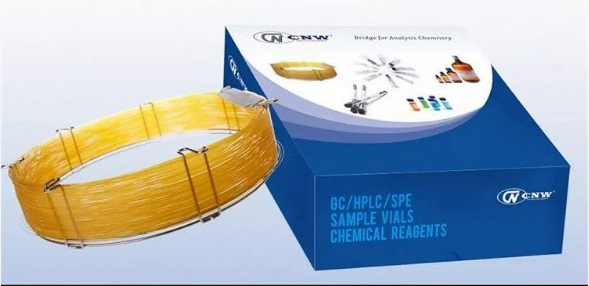
Yes, most of the gas chromatographic columns we have seen grow like above, like a reel of fishing line, but they are wound together in an orderly manner. Everyone must be gentle with me during use. Release to prevent me from being broken.
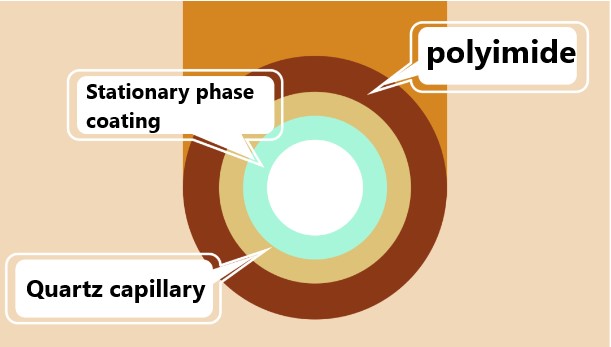
Everyone has seen my appearance, and I must be very curious about my inner part. I have a fused silica skeleton with a polyimide jacket on the outside to increase the toughness and corrosion resistance of the capillary. A thin layer of stationary phase coating.
After showing you the appearance of our family,
Now we are going to show you our inner life,
Knock on the blackboard,
You ask me to answer the beginning!


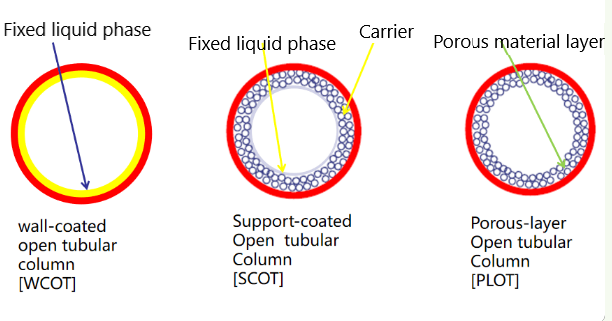
The open-ended capillary column can be divided into:
1. Wall-coated open-tube column (WCOT): pre-process the inner wall, and then apply the fixative on the inner wall of the capillary.
2. Carrier coated open-tube column (SCOT): In order to increase the amount of fixative in the open-column tube, a layer of very fine porous particles is coated on the tube wall, and then the fixed liquid is coated on the porous layer. The liquid film is thick, suitable for trace analysis.
3. Porous layer hollow column (PLOT): Coat a layer of porous adsorbent solid parti cles on the tube wall, and no more fixative. It is actually an open column tube for gas-solid chromatography. There is also a large-bore open-tube column that can tolerate a larger sample volume. Although the column efficiency is lower, it is much higher than the packed column.
Although there are different types of chromatographic columns, in actual use, we use the WCOT type the most. The common CD-5 and CD-WAX are of this type.

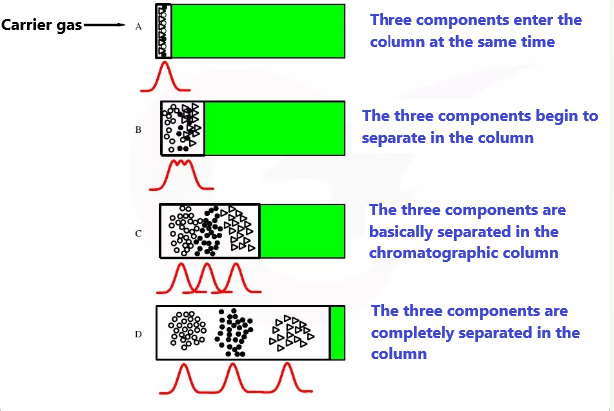
Gas chromatography is a physical separation method. Utilizing the small differences in the distribution coefficients (solubility) of the components of the tested substance bet ween the two phases, when the two phases move relative to each other, these substan ces are repeatedly distributed between the two phases, resulting in only small differen ces in properties. The effect of different components are separated.

Main parameters: column length, column inner diameter, film thickness
1. Column length: Column efficiency is directly proportional to column length, so longer columns will provide higher resolution.
In theory, if the length of the chromatographic column is doubled, the resolution will increase by 40%.
2. Inner diameter: Chromatographic column with fine inner diameter has higher column efficiency, which can improve the separation and shorten the analysis time;
Chromatographic columns with wide internal diameters can make up for the shortcomings of small internal diameter columns with small sample loading. As long as the method sensitivity can be achieved, it is recommended to use the smallest inner diameter as much as possible, so that the advantages of the column height of the small-bore chromatographic column can be used to achieve high separation ability.
3. Film thickness: thick film columns have higher retention of low boiling point compounds, and thinner film columns provide higher column efficiency.

The tolerance temperature of each chromatographic column is different. Normally, the lower the polarity, the better the temperature tolerance. For example, the weak polarity column CD-5 launched by Ampu has a maximum tolerance temperature of 325℃. The polar column CD-WAX can withstand a temperature of only 240℃.
The temperature tolerance of the chromatographic column can generally be found in two places, one is the nameplate of the capillary column, and the other is the certif icate.

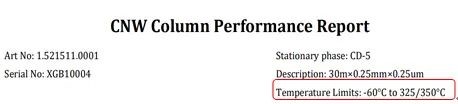
We see that there are two maximum temperature tolerances, and the lower upper temperature limit (325°C) is the upper limit of constant temperature, that is, the column can be used for a long time at this temperature. If it can be avoided, please try to stay below this temperature. The high upper temperature limit (350℃) represents the upper limit of the programmed temperature, which means that the column can only stay for a short time after rising to this temperature (generally no more than 15min), but it must not exceed this upper temperature limit, otherwise it will be severely damaged Fixing fluid, causing irreparable damage. Generally speaking, if the low temperature section can meet the analysis needs of the experiment, there is no need to set the temperature too high, because the higher the temperature, the greater the impact on the life of the stationary liquid, which is not conducive to the long-term use of the chromatographic column.

Column aging is mainly to remove some possible contaminants or some adsorbed volatile organic compounds. The presence of these non-target substances will interfere with the normal peak output of our chromatographic column and affect the separation performance. Aging chromatographic column is for We are ready for our upcoming separation experiment.

The open-ended capillary column can be divided into wall-coated open-tube colu mn WCOT, carrier-coated open-tube SCOT, porous layer hollow column PLOT column according to the different coating methods of the filled fixed liquid, but in actual use, we use WCOT the most Types of. The general steps for the aging of this type of column are: After installing the chromatographic column, first turn on the carrier gas for 5-10 minutes to blow away possible residual oxygen in the chromatographic column as muc h as possible, and then turn on the column thermostat, generally from 40℃ to The upp er limit of the method temperature is about +30 ℃, or the maximum use temperature of the column is 20-30 ℃, and then continue to age for about 2 hours. The carrier gas mu st be kept unobstructed during the whole process. Generally, the heating rate is reco mmended to be 5-10°C/min. For strongly polar chromatographic columns, such as WAX type, a slower heating rate of 5°C/min is recommended.

How to judge that the gas phase capillary column has been fully aged?
For capillary columns, generally after the aging is completed, follow the heating program we are about to use, take 1-2 spectra without sample injection, and then sup erimpose the spectra. If the spectra are basically consistent, we can judge, The aging is basically completed. It should be noted here that if you find that the baseline of the spectrum is higher in the low temperature section after the aging is completed, or there are ghost peaks, this is not a real column loss, but some parts in the system may be contaminated, because The loss of the chromatographic column generally only occurs in the high temperature section.

Don't worry, if you accidentally break it, you can use the fused silica connector to connect the broken capillary column and reuse it. The specific method is: first insert the capillary column into the fused silica connector, then vent carrier gas, heat the column oven to 220°C, and bake for 2 hours.
Anpel experiment has a fused silica capillary straight connector, Item No. GOEQ-072632, which can solve this problem!

This is the end of today’s Q&A session.
What do you guys do not understand,
You can continue to follow us!
What does the gas capillary column that play the leading role in gas chromat ogra phy look like?
Yes, most of the gas chromatographic columns we have seen grow like above, like a reel of fishing line, but they are wound together in an orderly manner. Everyone must be gentle with me during use. Release to prevent me from being broken.
Everyone has seen my appearance, and I must be very curious about my inner part. I have a fused silica skeleton with a polyimide jacket on the outside to increase the toughness and corrosion resistance of the capillary. A thin layer of stationary phase coating.
After showing you the appearance of our family,
Now we are going to show you our inner life,
Knock on the blackboard,
You ask me to answer the beginning!
The open-ended capillary column can be divided into:
1. Wall-coated open-tube column (WCOT): pre-process the inner wall, and then apply the fixative on the inner wall of the capillary.
2. Carrier coated open-tube column (SCOT): In order to increase the amount of fixative in the open-column tube, a layer of very fine porous particles is coated on the tube wall, and then the fixed liquid is coated on the porous layer. The liquid film is thick, suitable for trace analysis.
3. Porous layer hollow column (PLOT): Coat a layer of porous adsorbent solid parti cles on the tube wall, and no more fixative. It is actually an open column tube for gas-solid chromatography. There is also a large-bore open-tube column that can tolerate a larger sample volume. Although the column efficiency is lower, it is much higher than the packed column.
Although there are different types of chromatographic columns, in actual use, we use the WCOT type the most. The common CD-5 and CD-WAX are of this type.
Gas chromatography is a physical separation method. Utilizing the small differences in the distribution coefficients (solubility) of the components of the tested substance bet ween the two phases, when the two phases move relative to each other, these substan ces are repeatedly distributed between the two phases, resulting in only small differen ces in properties. The effect of different components are separated.
Main parameters: column length, column inner diameter, film thickness
1. Column length: Column efficiency is directly proportional to column length, so longer columns will provide higher resolution.
In theory, if the length of the chromatographic column is doubled, the resolution will increase by 40%.
2. Inner diameter: Chromatographic column with fine inner diameter has higher column efficiency, which can improve the separation and shorten the analysis time;
Chromatographic columns with wide internal diameters can make up for the shortcomings of small internal diameter columns with small sample loading. As long as the method sensitivity can be achieved, it is recommended to use the smallest inner diameter as much as possible, so that the advantages of the column height of the small-bore chromatographic column can be used to achieve high separation ability.
3. Film thickness: thick film columns have higher retention of low boiling point compounds, and thinner film columns provide higher column efficiency.
The tolerance temperature of each chromatographic column is different. Normally, the lower the polarity, the better the temperature tolerance. For example, the weak polarity column CD-5 launched by Ampu has a maximum tolerance temperature of 325℃. The polar column CD-WAX can withstand a temperature of only 240℃.
The temperature tolerance of the chromatographic column can generally be found in two places, one is the nameplate of the capillary column, and the other is the certif icate.
We see that there are two maximum temperature tolerances, and the lower upper temperature limit (325°C) is the upper limit of constant temperature, that is, the column can be used for a long time at this temperature. If it can be avoided, please try to stay below this temperature. The high upper temperature limit (350℃) represents the upper limit of the programmed temperature, which means that the column can only stay for a short time after rising to this temperature (generally no more than 15min), but it must not exceed this upper temperature limit, otherwise it will be severely damaged Fixing fluid, causing irreparable damage. Generally speaking, if the low temperature section can meet the analysis needs of the experiment, there is no need to set the temperature too high, because the higher the temperature, the greater the impact on the life of the stationary liquid, which is not conducive to the long-term use of the chromatographic column.
Column aging is mainly to remove some possible contaminants or some adsorbed volatile organic compounds. The presence of these non-target substances will interfere with the normal peak output of our chromatographic column and affect the separation performance. Aging chromatographic column is for We are ready for our upcoming separation experiment.
The open-ended capillary column can be divided into wall-coated open-tube colu mn WCOT, carrier-coated open-tube SCOT, porous layer hollow column PLOT column according to the different coating methods of the filled fixed liquid, but in actual use, we use WCOT the most Types of. The general steps for the aging of this type of column are: After installing the chromatographic column, first turn on the carrier gas for 5-10 minutes to blow away possible residual oxygen in the chromatographic column as muc h as possible, and then turn on the column thermostat, generally from 40℃ to The upp er limit of the method temperature is about +30 ℃, or the maximum use temperature of the column is 20-30 ℃, and then continue to age for about 2 hours. The carrier gas mu st be kept unobstructed during the whole process. Generally, the heating rate is reco mmended to be 5-10°C/min. For strongly polar chromatographic columns, such as WAX type, a slower heating rate of 5°C/min is recommended.
How to judge that the gas phase capillary column has been fully aged?
For capillary columns, generally after the aging is completed, follow the heating program we are about to use, take 1-2 spectra without sample injection, and then sup erimpose the spectra. If the spectra are basically consistent, we can judge, The aging is basically completed. It should be noted here that if you find that the baseline of the spectrum is higher in the low temperature section after the aging is completed, or there are ghost peaks, this is not a real column loss, but some parts in the system may be contaminated, because The loss of the chromatographic column generally only occurs in the high temperature section.
Don't worry, if you accidentally break it, you can use the fused silica connector to connect the broken capillary column and reuse it. The specific method is: first insert the capillary column into the fused silica connector, then vent carrier gas, heat the column oven to 220°C, and bake for 2 hours.
Anpel experiment has a fused silica capillary straight connector, Item No. GOEQ-072632, which can solve this problem!
This is the end of today’s Q&A session.
What do you guys do not understand,
You can continue to follow us!
The brilliant blue analysis of synthetic colorant analysis has noise interference?
Spectrum experiment to guard your SPE column flow rate
Leave a Reply
Your email address will not be published.Required fields are marked. *