By Anpel Team | 23 October 2020 | 0 Comments
Pipettes with different solvents
Why does the solvent leak out of the tip of the pipette tip when removing the solvent with a pipette? I believe that many small partners should have encountered this situation. Is it because the pipette is broken? That is not necessarily possible, because leakage occurs only when it is not sealed, so as long as a reliable tip is selected, the sealability of the pipette can be ensured. In addition, the leakage is likely to be related to the type of solvent removed (Please swipe down for specific explanation). In chemical laboratories, leakage due to the type of solvent is also more common. How to solve the leakage problem caused by the type of solvent?
1. First Step: Determine the type of solvent
First of all, before choosing the removal method, we must first determine the type of solvent, which can generally be divided into: aqueous solution, viscous liquid, volatile liquid and easy to foam liquid.
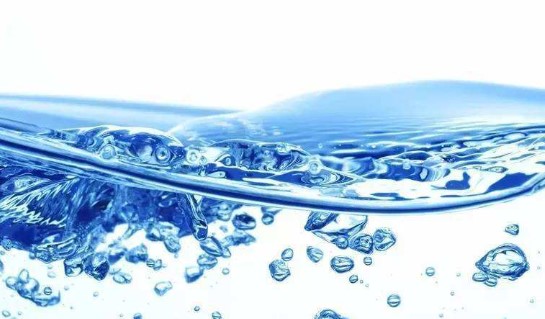
1.1 Aqueous solution
Including buffers, dilute salt solutions, dilute acids and dilute bases.
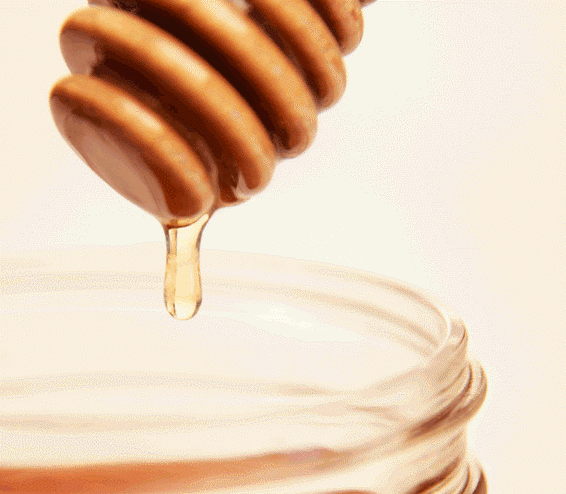
1.2 Viscous liquid
For example, honey and DMSO (dimethyl sulfoxide).
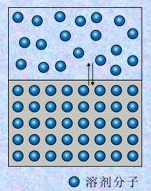
1.3 Volatile liquid
Low boiling point and high saturated vapor pressure solvent.
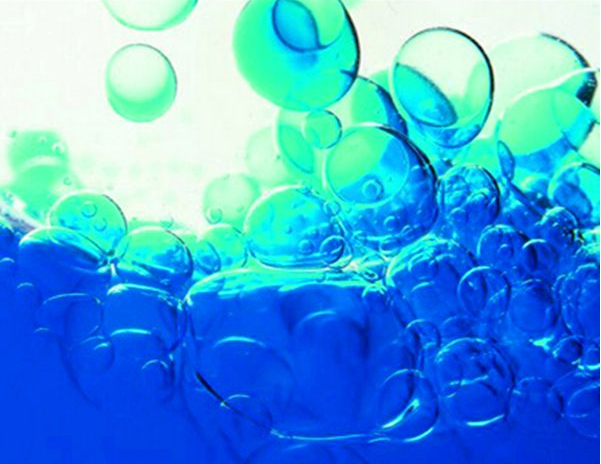
1.4 Liquid easy to foam
For example, many solutions with surfactants are very easy to foam.
2.Second Step:Choose the appropriate removal method according to the type of solvent
In order to improve the accuracy of pipetting, different solvent types have different pipetting methods. Therefore, after determining the type of solvent, select the best solvent removal method according to the following instructions. (Little friends who do not pursue pipetting accuracy at all, please feel free~)
2.1 Aqueous solution
✔ Positive aspiration method
Aqueous solution is the simplest type of solvent, select a conventional pipette tip when pipetting, and cooperate with the positive pipetting method.
Note: The forward pipetting operation is as follows.
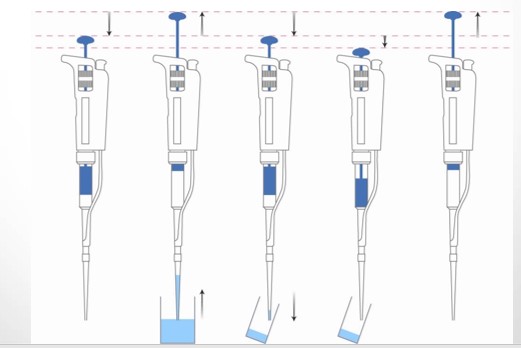
In order to improve the accuracy of pipetting, different solvent types have different pipetting methods. Therefore, after determining the type of solvent, select the best solvent removal method according to the following instructions. (Little friends who do not pursue pipetting accuracy at all, please feel free~)
2.1 Aqueous solution
✔ Positive aspiration method
Aqueous solution is the simplest type of solvent, select a conventional pipette tip when pipetting, and cooperate with the positive pipetting method.
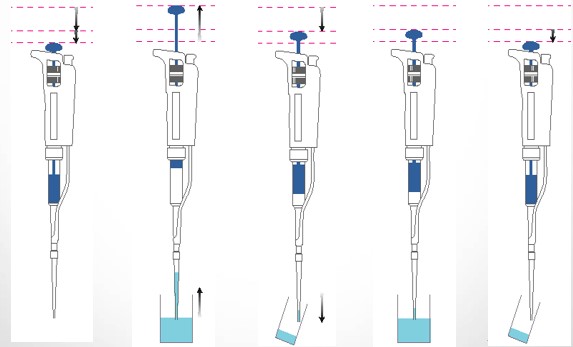
Note: The forward pipetting operation is as follows.
2.3 Volatile liquid
✔ Pre-moistened pipette tip (to make saturated vapor pressure inside the pipette to achieve gas-liquid balance)
✔ Reverse pipetting
✔ With filter tip
✔ External piston pipette
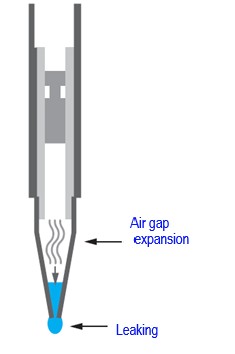
Volatile solvents have a high saturated vapor pressure, so the solvent will continuously volatilize after entering the tip to reach its saturated vapor pressure, so that the air pressure inside the pipette is greater than the outside, so that the liquid in the tip is pressed out. This is the reason why people always leak liquid when removing volatile liquid, so the leak is not necessarily a problem with the sealing of the pipette.
Pre-wash the tips 5-6 times, so that the saturated vapor pressure is formed inside the pipette to achieve gas-liquid balance, so that the liquid leakage can be improved; or the tip with a filter element can also prevent the liquid from dripping. . At the same time, with the reverse suction method to improve accuracy. It is better to choose an external piston pipette, and its accuracy will be better. In the absence of an external piston pipette, in order to improve accuracy, you can prepare a pipette and calibrate this solvent specifically.
Note: For liquids with strong volatility and strong corrosivity (such as concentrated acid, concentrated alkali, etc.) can not be removed with a pipette, because it will corrode the internal accessories of the pipette.
2.4 Liquid easy to foam
✔ Reverse pipetting
✔ Low suction tip
✔ External piston pipette
The easy-foaming liquid has strong adsorption on the inner wall of the suction head, and is easy to foam at the same time. Therefore, a low-absorption tip should be selected, and the reverse suction method should be used. An external piston pipette can also be used, because the external piston pipette does not have an air column when removing liquid, and no air column is equivalent to no bubbles, and how many rows does the external piston pipette suck? How much, there is no problem of liquid sticking to the inner wall of the tip.
1. First Step: Determine the type of solvent
First of all, before choosing the removal method, we must first determine the type of solvent, which can generally be divided into: aqueous solution, viscous liquid, volatile liquid and easy to foam liquid.
1.1 Aqueous solution
Including buffers, dilute salt solutions, dilute acids and dilute bases.
1.2 Viscous liquid
For example, honey and DMSO (dimethyl sulfoxide).
1.3 Volatile liquid
Low boiling point and high saturated vapor pressure solvent.
1.4 Liquid easy to foam
For example, many solutions with surfactants are very easy to foam.
2.Second Step:Choose the appropriate removal method according to the type of solvent
In order to improve the accuracy of pipetting, different solvent types have different pipetting methods. Therefore, after determining the type of solvent, select the best solvent removal method according to the following instructions. (Little friends who do not pursue pipetting accuracy at all, please feel free~)
2.1 Aqueous solution
✔ Positive aspiration method
Aqueous solution is the simplest type of solvent, select a conventional pipette tip when pipetting, and cooperate with the positive pipetting method.
Note: The forward pipetting operation is as follows.
In order to improve the accuracy of pipetting, different solvent types have different pipetting methods. Therefore, after determining the type of solvent, select the best solvent removal method according to the following instructions. (Little friends who do not pursue pipetting accuracy at all, please feel free~)
2.1 Aqueous solution
✔ Positive aspiration method
Aqueous solution is the simplest type of solvent, select a conventional pipette tip when pipetting, and cooperate with the positive pipetting method.
Note: The forward pipetting operation is as follows.
2.3 Volatile liquid
✔ Pre-moistened pipette tip (to make saturated vapor pressure inside the pipette to achieve gas-liquid balance)
✔ Reverse pipetting
✔ With filter tip
✔ External piston pipette
Volatile solvents have a high saturated vapor pressure, so the solvent will continuously volatilize after entering the tip to reach its saturated vapor pressure, so that the air pressure inside the pipette is greater than the outside, so that the liquid in the tip is pressed out. This is the reason why people always leak liquid when removing volatile liquid, so the leak is not necessarily a problem with the sealing of the pipette.
Pre-wash the tips 5-6 times, so that the saturated vapor pressure is formed inside the pipette to achieve gas-liquid balance, so that the liquid leakage can be improved; or the tip with a filter element can also prevent the liquid from dripping. . At the same time, with the reverse suction method to improve accuracy. It is better to choose an external piston pipette, and its accuracy will be better. In the absence of an external piston pipette, in order to improve accuracy, you can prepare a pipette and calibrate this solvent specifically.
Note: For liquids with strong volatility and strong corrosivity (such as concentrated acid, concentrated alkali, etc.) can not be removed with a pipette, because it will corrode the internal accessories of the pipette.
2.4 Liquid easy to foam
✔ Reverse pipetting
✔ Low suction tip
✔ External piston pipette
The easy-foaming liquid has strong adsorption on the inner wall of the suction head, and is easy to foam at the same time. Therefore, a low-absorption tip should be selected, and the reverse suction method should be used. An external piston pipette can also be used, because the external piston pipette does not have an air column when removing liquid, and no air column is equivalent to no bubbles, and how many rows does the external piston pipette suck? How much, there is no problem of liquid sticking to the inner wall of the tip.
Selection and use of manual injection needle
Filtering products do not know how to choose? One article takes you to reveal the common problems of
Leave a Reply
Your email address will not be published.Required fields are marked. *